
Designing the Interior of the Glutton Dome

The interior of the Glutton Dome began as a question rather than a plan.
What kind of space does food need when it becomes performance?
At first, the Dome lived inside a zoo, after hours.
By day, animals played their expected roles for human visitors.
By night, when the gates closed, another world woke up — Vincent’s world.
In that early version, the stage did double duty.
A monkey enclosure during the day.
A kitchen arena at night.
It was playful and theatrical, but it carried limits we could feel as the story grew.
So we let it go.
Cooking as Performance

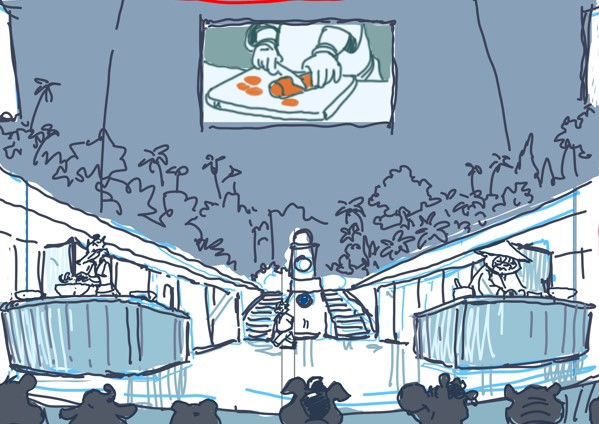
We kept returning to one touchstone: Iron Chef.
Not for the food — but for the drama.
Cooking as ritual.
As movement.
As spectacle.
That feeling shaped everything that followed.
The stage needed to hold tension without chaos.
It had to support motion, visibility, and focus — a place where cooking feels alive, not ornamental.
Not a platform.
An arena.
Finding the Right Stage


traditional arena puts the action dead center.
But a chef can’t turn their back on half the room.
The solution was a stage near the center — not in it.
Surrounded by energy, but still engaged with the audience.
Behind the stage, we introduced a living wall.
Plants. Water. Texture.
The inspiration came from somewhere personal — the Rainforest Café, a favorite place from our kids’ early years.
That sense of wonder stayed with us.
Arrival from Above


Vincent doesn’t always arrive from the wings.
Sometimes, he comes from above.
The circular stained-glass roof opens and closes over the arena.
Light pours in.
The space shifts.
Inspired by places like Casa Milà’s atrium and the spectacle of stadium architecture, this vertical movement makes the Dome feel responsive — as if it’s part of the performance.
Light, Scale, and Breath
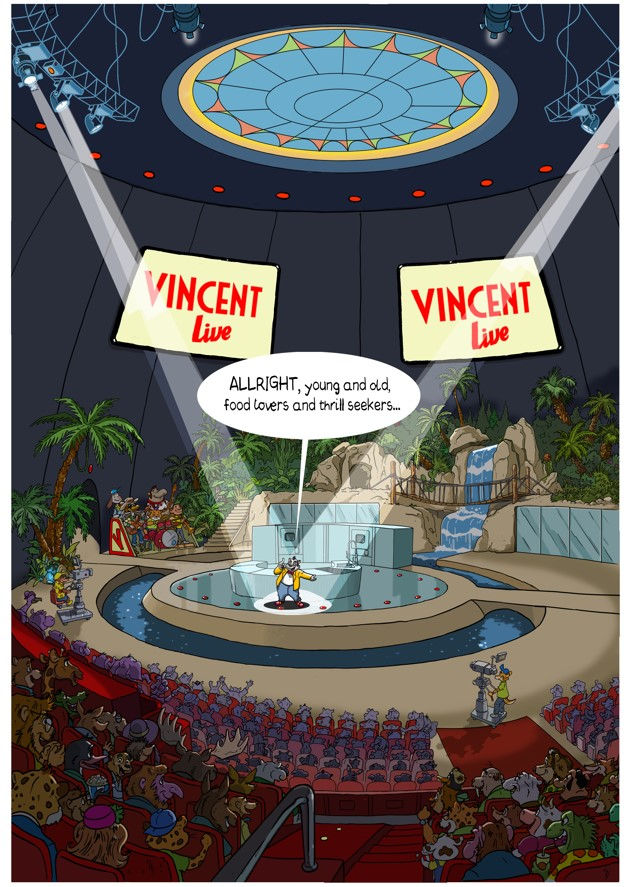
The Glutton Dome is vast.
Thousands of seats. Shared energy.
We wanted that scale to be felt — not explained.
Wide shots suggest the crowd.
Closer frames bring intimacy.
Light does the rest.
It pools on the stage, moves through the space, and guides the eye.
Just as important are the quiet moments — when the Dome feels cavernous, waiting, almost reflective.
We thought of the interior as a character.
Expressive. Theatrical. Alive.
Designing the Glutton Dome wasn’t about fixing a single look.
It was about creating a space that could grow and shift — evolving alongside the story.


A great read. Fun project. I'm looking forward to more...